The field of Artificial Intelligence was founded in 1956 by a handful of scientists, who had been inspired by the invention of the programmable digital computer in the 1940's, capable of performing mathematical calculation. The group forecast that a machine, matching the level of intelligence of a human being would be in existence, 'in no longer than a generation'. Obviously those predictions turned out to be wildly optimistic.
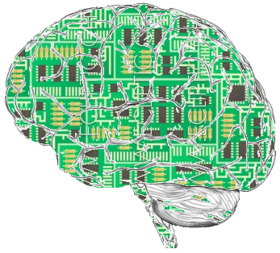
The idea of copying the brain and its functionality seems a very feasible one; however, there are many things that are extremely difficult for a machine to comprehend. The human brain makes use of rational thinking and reasoning, stemming from the ability to assess the current situation or circumstance. These cognitive processes come from prior knowledge contained within the mind, that determine the behavior of the individual. In order for Artificial Intelligence to rationalise the situation in a similar way, it would require existing knowledge of its environment, the situation and how to deal with it - much like a human being.
The only obvious way to overcome this problem, is to teach the machine the knowledge it needs; however, this would require an astronomical amount of information. A long-standing problem was the lack of computer power, although this is increasing rapidly as each year goes by, which in turn creates more and more possibilities. A project was started in the 1980's that addressed the knowledge problem, by simply teaching a machine human concepts, one at a time, with the creator arguing that there is no shortcut. However, this project was not expected to be completed for some decades.
There is a clear paradox with Artificial Intelligence when compared to human beings, as they can solve the most complex mathematical problems, but find great difficulty in moving from one side of the room to the other without bumping into anything!
There are huge problems to overcome but I believe that they can solve all of the major issues in time. Solutions have recently been discovered that seemed impossible just decades ago - some of the original goals set in the 1950's are finally being achieved. For example, for the first time, in 1997, a computer (Deep Blue) beat the reigning world chess champion. This was predicted to occur decades earlier; a forecast which failed to deliver on time.
Artificial Intelligence raises the philosophical issue of the mind and body. Is the mind a result of the human body and its processes, or is the mind a separate matter that is simply located in a human body (a soul)? These ancient questions could well be answered as research into AI continues.
If a machine is developed, which has the intelligence level of a human being, the impact it would have on the world would be, in my opinion, so great that it is difficult to even comprehend at this time. The world - as we know it - would not exist. It would be like a revolution. Human tasks would be minimised to an extreme and there would not be the same demands on the human mind. Such a transition could de-value the human life and create a very disposable world.
Despite the dramatic alteration in the way we live our lives, it is likely that humans will be eased into a world of AI, so they will be able to cope with the transition as it will simply be the norm - much like the world we live in now is the norm to us. I believe the current environment is the beginning of this transition, as technology begins to surpass everybody's expectations.
Bibliography
http://paraqa.com/downloads/Bender_(Futurama).png (Image 1)
http://en.wikipedia.org/wiki/History_of_artificial_intelligence#AI_in_myth.2C_fiction_and_speculation (Research)
http://upload.wikimedia.org/wikipedia/commons/thumb/1/17/ArtificialFictionBrain.png/280px-ArtificialFictionBrain.png (Image 2)